 Abdur Razzak
AI skin analysis apps use a phone camera, questionnaire, product database, or recommendation algorithm to help people understand visible skin features and organise skincare choices. They can make product research and routine tracking more convenient, but their results are estimates—not a diagnosis, a guarantee that a product will work, or a substitute for a dermatologist.
If you are considering an AI skincare app, the important questions are not just how impressive its scan looks. You also need to know what the app actually measures, whether its claims have been independently validated, how well it works across different skin tones and devices, whether recommendations are commercially influenced, and what happens to your face photos and personal data.
This guide explains how AI skin analysis apps work, what they can and cannot do, how to evaluate accuracy and safety, and how to choose a tool without relying on exaggerated claims. It is intended for people researching consumer skincare technology—not for diagnosing or treating a skin condition.
Quick Answer: Are AI Skin Analysis Apps Worth Using?
An AI skincare app may be useful when you want to organise product information, compare ingredients against your preferences, create routine reminders, or record non-diagnostic observations over time. A camera-based skin analysis can provide a visual estimate of selected features under specific image conditions.
It is not a reliable stand-alone way to diagnose acne, eczema, rosacea, skin cancer, infections, or the cause of a new or changing skin mark. A scan score should not decide whether you need medical care. The value of an app depends on its intended purpose, evidence, transparency, privacy practices, and how carefully you interpret its output.
- Useful for: product research, ingredient education, routine organisation, reminders, and personal tracking.
- Use caution with: skin scores, claims about detecting conditions, product recommendations, and before-and-after comparisons.
- Do not rely on it for: diagnosis, ruling out disease, treatment decisions, or urgent assessment of a changing skin lesion.
Best AI Skin Analysis App: What Should You Compare?
People searching for the best AI skin analysis app, a free AI skin analysis app, or an AI skin scanner are often looking for different things. Some want a quick face scan from a selfie; others want a skincare routine, ingredient recommendations, progress tracking, or a tool that works in a browser without installing an app. There is no universal winner, so compare the feature you actually need rather than choosing an app because it advertises the highest skin score.
Free AI skin analysis app or paid subscription?
Check what the free version actually includes. Some services offer a free download but restrict detailed scan results, saved history, or routine recommendations to a paid plan. Before starting a trial, check the renewal price, trial length, cancellation process, and whether a payment method is required. A free first scan is not the same as unlimited free skin analysis.
Skin analysis app online vs. a mobile AI skin scanner
A skin analysis app online may run in a mobile or desktop browser and avoid an installation. A mobile face skin analysis app may offer saved scans, reminders, or progress tracking. In either case, check whether the selfie is uploaded, how long it is retained, and whether the provider explains its image-processing practices.
AI skin analysis app for Android or iPhone
Compatibility varies by product and version. If you need an AI skin analysis app for Android or an AI skin analysis app for iPhone, verify the current Google Play or Apple App Store listing, supported operating-system version, region availability, and in-app purchase details. Do not assume that a tool available on one platform is also available on the other.
Questions to ask before choosing a skin analyzer app
- Does the skin analyzer app explain which visible features it estimates and which it cannot assess?
- Can you use the tool for skin analysis from a selfie without creating an account or starting a subscription?
- Does it save scan history, and can you delete your photos and account data?
- Are recommendations based on a broad product database, a single brand, or paid partnerships?
- Does the provider clearly state that a cosmetic AI skin scanner is not a medical diagnosis?
These checks are more useful than an unsupported “number one” label. App features, prices, platform support, and privacy terms change, so confirm them on the provider’s current website or app-store listing before relying on a comparison.
What Are AI Skin Analysis Apps?
AI skin analysis apps are consumer or professional software tools that use artificial intelligence or other automated methods to interpret information about skin. Depending on the product, the input may be a selfie, a close-up photograph, a questionnaire, a list of current skincare products, or observations entered by the user.
The output may be a set of visible-feature estimates, a skin score, an ingredient explanation, a suggested cosmetic routine, a product match, or a record that can be compared with later observations. These functions are not interchangeable. An app that matches a user’s preferences to a product catalogue does not necessarily analyse an image, and an app that detects a visual pattern has not automatically been validated to diagnose a medical condition.
AI skincare app vs. AI dermatology app
The distinction matters because the intended purpose changes the level of evidence and oversight a user should expect.
| Tool type | Typical purpose | What to check |
|---|---|---|
| Cosmetic skincare recommender | Match preferences or stated concerns with products and routines | Ingredient data, recommendation logic, sponsorship, and limitations |
| AI skin-analysis app | Estimate selected visible features from a photograph | Image conditions, validation, skin-tone coverage, and repeatability |
| Routine or skin diary app | Record products, reminders, and user-observed changes | Data export, privacy, reminders, and whether claims stay non-diagnostic |
| AI dermatology or diagnostic software | Support clinical assessment or a defined medical purpose | Clinical evidence, intended-use statement, professional oversight, and applicable regulatory status |
Marketing language can blur these categories. Read the app’s description and terms to understand whether it offers cosmetic guidance, general health information, or a medical function.
How Does AI Skin Analysis Work?
There is no single method used by every AI skincare app. A typical image-based workflow may include the following stages.
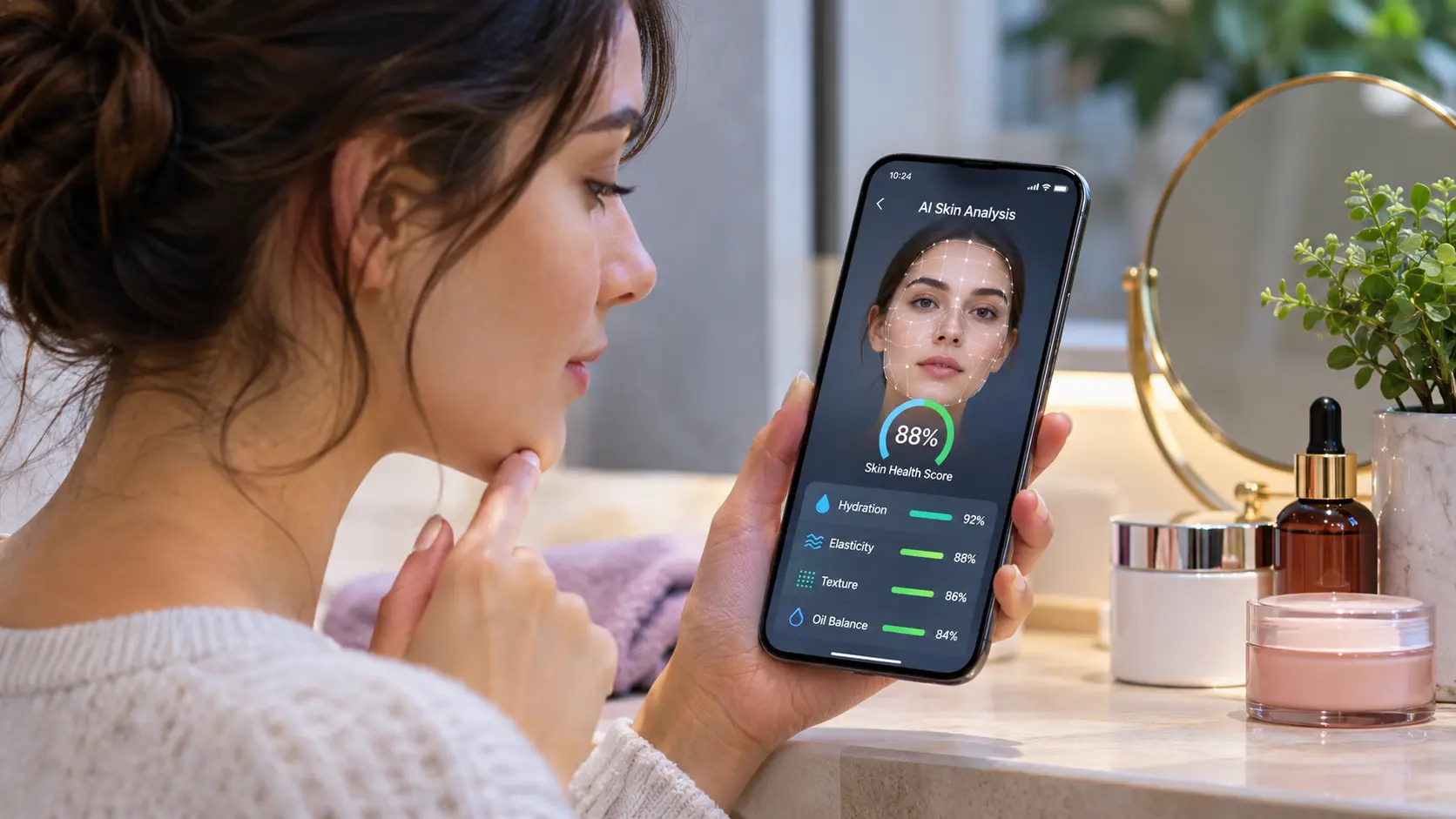
1. Image capture and quality checks
The user takes or uploads a face photograph. Some apps ask for natural light, a neutral expression, no makeup, and a consistent camera distance. Others use an on-screen guide to position the face. These instructions matter because shadows, reflections, camera processing, filters, compression, and changes in angle can alter the image.
2. Image processing and computer vision
Computer vision is the field of technology that enables software to interpret visual information. A model may identify facial regions, locate areas of interest, or estimate visible patterns in the image. Machine learning models learn statistical patterns from training examples; they do not examine skin in the same way as a clinician.
Some systems use image segmentation to separate regions, classification to assign labels, or detection methods to locate particular visual patterns. The model’s output is limited by the quality, relevance, and diversity of the data used to develop and test it.
3. Questionnaire and profile matching
Other apps collect user-reported information such as product preferences, budget, fragrance preferences, or the user’s stated goals. A recommendation engine can compare these answers with product attributes. This may be a rules-based system rather than a sophisticated AI model. A useful app should explain what information it uses and allow users to correct inaccurate profile details.
4. Recommendation generation
The app may turn its analysis or questionnaire into a list of suggested products or a routine. The recommendation may come from a product database, brand catalogue, ingredient filters, or commercial partnerships. A product appearing first in a list is not necessarily the most suitable product for an individual.
5. Progress tracking
Some apps store scans or user notes so people can compare observations over time. A meaningful comparison requires consistent capture conditions and a clear explanation of what is being measured. A changing score does not prove that a product caused an improvement or that a medical condition has improved.
What Can AI Skincare Apps Analyse?
Depending on the app and its validation, a tool may estimate selected visible characteristics such as:
- Acne-like visible features: some systems attempt to locate or count visible blemish patterns. A photograph cannot establish the underlying cause or severity of acne.
- Redness: image tools may estimate visible redness, but lighting, warmth, irritation, camera white balance, and skin tone can affect the result.
- Dark spots and pigmentation: an app may highlight areas of differing colour. It cannot reliably determine the cause of a spot or rule out a concerning lesion.
- Texture and pores: close-up images may be used to estimate visible texture or pore appearance. Resolution, focus, and image enhancement can change these estimates.
- Fine lines and wrinkles: some tools estimate visible lines or texture. Expression, angle, hydration, and lighting can influence the image.
- Oiliness or dryness: a camera cannot directly measure every factor involved in skin oil or hydration. Some apps combine visual estimates with questionnaire answers, which should be made clear to users.
These are examples of consumer-facing claims, not a list of universally validated AI capabilities. Before trusting a metric, look for evidence that the specific system has been tested for that exact task and intended user group.
What Are the Benefits of AI-Personalised Skincare?
AI-personalised skincare tools can make everyday skincare research more organised by bringing product information, ingredient explanations, routine planning, and personal tracking into one place. Depending on the app, they may help users compare options against their preferences and keep a consistent record of the products they use. These features are most useful as decision-support tools: they can save time and make information easier to manage, but they cannot guarantee results or replace professional advice for a medical skin concern.
More organised product discovery
Product catalogues can be difficult to compare. A tool that lets users filter by budget, texture, fragrance preferences, or selected ingredients may make research more manageable. The benefit is convenience and organisation—not proof that an algorithm has discovered a perfect product.
Ingredient information in simpler language
An ingredient scanner or product database may help explain common cosmetic ingredient names and identify information that a user wants to investigate. Treat summaries as a starting point. Check the full ingredient list, product directions, warnings, and manufacturer information, especially if you have known sensitivities.
Routine planning and reminders
A simple morning or evening checklist can help users remember the order in which they intend to use products. Reminders may also help people follow the directions supplied with a product. A routine should remain understandable and manageable; adding more products is not automatically better.
Personal records and consistency
A diary can help record when a product was introduced, what the user noticed, and whether a routine was followed. This information may be useful when discussing a concern with a professional. It should not be interpreted as a controlled experiment or clinical outcome.
More informed questions
When an app explains its limits and sources, it may help a user prepare questions for a dermatologist or pharmacist. The strongest consumer benefit may be better organisation and understanding—not automated diagnosis.
How Accurate Are AI Skin Analysis Apps?
There is no single accuracy score for AI skincare apps. Performance depends on the exact task, the model, the images, the reference standard, the people included in testing, and the conditions in which the app is used. A result from a controlled research dataset cannot automatically be applied to a selfie taken at home.
Why one skin scan can produce a different result
- Lighting: warm indoor bulbs, direct sunlight, shadows, and reflections can change visible colour and contrast.
- Camera differences: sensors, lenses, image processing, and resolution vary between phones.
- Distance and angle: perspective and focus can affect the apparent size and visibility of features.
- Makeup and skincare products: cosmetics, sunscreen, shine, and residue may affect image interpretation.
- Filters and retouching: beauty filters or automatic image enhancement may conceal or alter visible features.
- Temporary changes: exercise, temperature, irritation, or other short-term factors may affect appearance.
If an app provides a score, ask what the score represents, whether it has a defined scale, how it was validated, and what size of change is meaningful. A score without a clear measurement method can create a false impression of scientific precision.
Understand sensitivity, specificity, and false results
For tools that claim to identify a medical condition, two terms are especially important:
- Sensitivity: how often a test correctly identifies people who have the condition in the tested population.
- Specificity: how often a test correctly identifies people who do not have the condition in the tested population.
A system can miss a condition (a false negative) or flag something that is not the condition (a false positive). The consequences depend on the task. A cosmetic recommendation error may waste money or irritate skin; a missed medical warning can delay appropriate care. This is why a diagnostic claim needs stronger evidence than a convenience feature.
What does independent validation mean?
Independent validation means evaluating a model using data and methods that were not simply part of its development process, ideally with relevant users, devices, and real-world conditions. Look for details about the number of participants or images, the reference standard, the demographic mix, the confidence intervals, and whether the results were independently reviewed or published.
Be cautious when an app advertises a high accuracy percentage but does not explain the tested task, dataset, comparison method, or limitations. An accuracy figure for one narrow task is not proof that the app can assess every skin concern.
What Research Says About AI Dermatology Apps in 2026
Published research supports a careful rather than an all-or-nothing view. AI has potential in dermatology, but the evidence for a particular clinical task should not be confused with validation of every consumer skincare app.

Cosmetic formulation research involves examining ingredients and testing product samples.
2024: A review of dermatology apps with AI features
A cross-sectional study published in JAMA Dermatology in 2024 assessed 41 dermatology mobile apps with AI features. The researchers identified concerns including limited supporting evidence, insufficient clinician or dermatologist input, opaque algorithm development, questionable data-use practices, and inadequate privacy protection. The authors concluded that inconsistent validation and misleading communication could create risks for users.
Read the JAMA Dermatology study.
2025: A systematic review of skin-lesion AI and fairness
A 2025 systematic review and meta-analysis in Medicina examined AI systems used to assess skin lesions across clinical, dermoscopic, and smartphone images. The review reported lower pooled performance in darker skin-tone groups than in lighter groups in the included studies, and differences between specialist and smartphone settings. These findings concern lesion-diagnosis systems; they should not be presented as a direct accuracy rating for cosmetic skin-analysis apps. They do, however, demonstrate why skin-tone representation and real-world validation matter.
Read the systematic review and meta-analysis.
2026: European review of dermatology smartphone applications
A 2026 review by the European Academy of Dermatology and Venereology (EADV) AI Task Force examined dermatology apps across 44 European countries. The researchers identified 1,746 apps in their 2024 app-store search, with 420 meeting the review’s inclusion criteria. In the 2024 app sample, 12% reported AI functionality; among those AI apps, 41% focused on skin-cancer diagnosis. The review reported limited scientific validation: 20% of the included apps linked to peer-reviewed publications, 24 had clinical-trial evaluations, five had randomized controlled trials, and six had real-world post-deployment studies.
The study also updated its search for AI-based skin-cancer screening apps in June 2026, identifying 38 apps. It found that adherence to several EADV recommendations—including explainability, inclusivity, and data-sharing principles—was poor, with these principles met by no more than 37% of apps. These findings relate to the review’s defined app samples and should not be generalised to every skincare product or every AI application. They do show why consumers should look beyond marketing claims.
What these studies mean for consumers
The practical lesson is not that every AI skincare app is unsafe. It is that the label “AI-powered” is not evidence of accuracy. A responsible choice requires clear intended use, appropriate validation, transparent limitations, inclusive testing, privacy safeguards, and a route to professional care when a medical concern is involved.
AI Bias: Does Skin Tone Affect Skin Analysis?
AI models learn patterns from the examples used to train and evaluate them. If those examples do not adequately represent the people who will use the product, performance may differ between groups. In image-based dermatology, skin tone, lighting, image quality, and the type of condition being assessed can all influence performance.
Ask the developer:
- Were the training and test datasets diverse in skin tone, age, and relevant skin conditions?
- Were results reported separately for different skin-tone groups?
- Was the model tested on different phone cameras and real-world lighting conditions?
- Has performance been checked after the app was released and updated?
- Does the provider clearly explain groups or situations where the tool may be less reliable?
Fitzpatrick skin phototypes are sometimes used in dermatology research to describe how skin responds to ultraviolet exposure. They are not a complete measure of racial or ethnic identity, and they should not be treated as a substitute for inclusive testing. A credible evaluation should explain how participants were grouped and what the categories can—and cannot—tell readers.
AI Skincare Recommendations: How to Check Product Suggestions
Some apps turn a scan or questionnaire into a list of products. Before following that list, separate the matching process from the evidence for the product itself.
Check the ingredient list, not just the app’s score
Read the product’s full ingredient declaration and instructions. An app summary may omit concentration, formulation, product stability, usage directions, or warnings. Ingredient names alone do not tell you how a finished formulation will perform.
Look for sponsorship and affiliate relationships
Find out whether the app recommends products from a limited partner catalogue, earns commission from purchases, or prioritises its own brand. A commercial relationship does not automatically make a recommendation unsuitable, but it should be disclosed so users can interpret the suggestion fairly.
Do not assume more products mean better results
A long routine can be expensive and difficult to follow. Be wary of apps that create urgency, promise rapid transformation, or encourage repeated purchases without explaining the basis for each suggestion. Follow product directions and seek professional advice for persistent reactions or medical concerns.
Compare recommendations against your actual needs
Use an app’s output as a shortlist to investigate. Consider your budget, preferences, known sensitivities, product directions, and whether the recommendation is supported by reliable information. Do not treat a product match as an individual medical prescription.
AI Skincare App Privacy: What Happens to Your Face Photo?
A face photograph and the information attached to it can be personal data. Depending on how the app processes the image and what information it infers, additional privacy rules may apply. Do not assume that a photo is anonymous simply because your name is not displayed beside it.
Six privacy questions to ask before uploading a selfie
- Where is the image processed? Is analysis performed on the device or uploaded to the provider’s servers?
- How long is it retained? Is the image deleted after analysis, stored in an account, or retained for another stated period?
- Is it used for model training? Can the provider use your image or derived data to train, test, or improve its systems?
- Who receives the data? Does the provider share information with analytics companies, advertising partners, cloud providers, or other third parties?
- Can you delete it? Is there a practical process to delete the image, account, and associated information?
- Are permissions proportionate? Does the app request access to contacts, location, microphone, or other data that is not needed for the feature?
GDPR and users in the European Economic Area
For people in the European Economic Area, read the provider’s privacy notice and identify the organisation responsible for processing your information. The GDPR treats health data as a special category of personal data. Biometric data is also a special category when processed for the purpose of uniquely identifying a person; not every ordinary face photograph automatically falls into that category. The legal classification depends on the data and processing involved.
Look for a clear explanation of the purpose, legal basis, retention period, recipients, international transfers where relevant, and how to exercise applicable data-protection rights. If the provider’s policy is vague or you cannot understand what happens to your image, consider not uploading it.
Regulation: FDA, CE Marking, and Medical-Device Claims
Regulatory status depends on the software’s intended purpose and the jurisdiction. A cosmetic product-matching tool and software intended to diagnose a medical condition may be treated differently. Do not assume that every beauty app needs medical-device authorisation, or that a general disclaimer makes a diagnostic claim safe.
United States: FDA oversight is function-specific
The US Food and Drug Administration explains that some software functions meet the definition of a medical device and may fall under its oversight, depending on their intended medical purpose and risk. The FDA’s policy is function-specific; it does not mean that every wellness or cosmetic app is FDA-cleared, nor that every app must follow the same regulatory pathway.
When an app claims to diagnose a condition or guide treatment, check the exact product and function in the relevant FDA information rather than relying on a badge or a developer’s general statement.
FDA: Policy for Device Software Functions and Mobile Medical Applications.
European Union: intended purpose and applicable medical-device rules
In the European Union, software with a medical intended purpose may fall within the Medical Device Regulation (MDR), depending on its intended purpose and classification. A CE mark is not a universal quality badge for all consumer skincare apps. Where a developer makes a medical-device claim, check what product or software function the conformity information actually covers and whether it is relevant to the feature being promoted.
For consumers, the safest approach is to distinguish a cosmetic recommendation feature from a function that claims to detect, diagnose, monitor, or guide treatment of a disease. If the app’s claims are unclear, do not rely on it for a medical decision.
How to Choose an AI Skin Analysis App: A 10-Point Checklist
- Define your goal. Do you want product research, routine reminders, a skin diary, cosmetic image estimates, or clinical support? Choose a tool designed for that purpose.
- Read the intended-use statement. Check whether the app explicitly says it is not a diagnostic tool and whether its marketing makes stronger claims elsewhere.
- Look for independent evidence. Prefer published evaluation of the actual app or model, not a generic claim about AI or a different product.
- Check the test population. Look for skin-tone, age, device, and condition diversity that matches the people expected to use the tool.
- Understand each score. Ask what a metric measures, how it is calculated, and whether changes are meaningful.
- Review the recommendation model. Check whether suggestions are based on preferences, ingredient data, a partner catalogue, or sponsored placements.
- Read the privacy policy. Understand image storage, model training, sharing, deletion, and permissions before uploading a photo.
- Check costs and renewal terms. Review trial periods, subscription prices, automatic renewal, cancellation steps, and in-app purchases.
- Look for human support. A responsible service should explain when to stop using the app and seek professional advice.
- Be alert to exaggerated promises. Guaranteed results, definitive diagnoses from a selfie, pressure to buy immediately, or claims that discourage medical care are warning signs.
How to Take a More Consistent Skin Photo for Tracking
If you use a non-diagnostic app to record visible changes, consistency can make the record easier to interpret. It does not make the app clinically accurate, but it may reduce avoidable variation between photographs.
- Use the same device and camera when practical.
- Choose even, indirect lighting and avoid strong shadows.
- Use a similar distance, angle, and facial expression each time.
- Avoid beauty filters, portrait retouching, and image enhancement.
- Follow the app’s instructions about makeup and product residue.
- Record the date and any relevant changes in products or routine.
- Do not use photo comparisons to decide whether a suspicious or changing lesion is harmless.
If the app does not explain how images are stored or how to remove them, do not upload a photo simply to obtain a score.
AI Skincare Apps vs. Traditional Skincare Research
| Approach | Potential advantage | Important limitation |
|---|---|---|
| AI skincare app | Fast organisation of images, preferences, product data, or reminders | Quality varies by tool; outputs may be opaque or commercially influenced |
| Product label and manufacturer information | Direct access to ingredients, directions, warnings, and product details | May not explain how a product fits an individual’s circumstances |
| Independent consumer research | Can compare multiple sources and identify common concerns | Reviews and online claims may be anecdotal or commercially motivated |
| Dermatologist consultation | Can consider symptoms, medical history, examination, and clinical context | Requires access to a qualified professional and may involve cost or waiting time |
These approaches can complement one another, but they do not have equal roles. An app may help organise information; a clinician is the appropriate person to assess a medical concern.
When Should You Stop Using an App and Seek Professional Advice?
Do not wait for an app score if you have a new or changing skin lesion, a sore that does not heal, persistent or worsening symptoms, significant pain, swelling, signs of infection, or a reaction that concerns you. A dermatologist or another qualified healthcare professional can assess the issue in context. If symptoms are severe or rapidly worsening, seek urgent medical care through the appropriate local service.
Do not let a reassuring app result delay an examination. Equally, do not assume that an app-generated warning proves that you have a disease. Both false reassurance and unnecessary alarm are possible when software is used outside its validated purpose.
Frequently Asked Questions About AI Skin Analysis Apps
Is there a free AI skin analysis app?
Some tools provide a free scan or basic features, while others charge for detailed reports, saved scan history, or routine recommendations. Check what is included without payment, whether a trial renews automatically, and the current price in your country. “Free to download” does not always mean the full skin analysis is free.
Can I use an AI skin analysis app online without downloading it?
Some skin analysis tools work through a browser, while others require an iPhone or Android app. Check the provider’s current requirements and privacy notice before uploading a selfie. Browser-based access does not automatically mean that your photo is processed only on your device.
Which AI skin analysis app works on Android and iPhone?
Platform support differs between providers and can change with app updates or regional availability. Check the current Google Play and Apple App Store listings for supported devices, operating-system versions, and subscription details rather than relying on an old comparison.
What is the best AI skin analysis app?
There is no single best app for every person or purpose. Some tools focus on cosmetic product matching, others on routine tracking, and others make medical or diagnostic claims. Compare the exact feature you need, independent validation, skin-tone coverage, privacy practices, commercial relationships, and total cost. This guide does not rank apps because a reliable ranking would require current, hands-on testing of specific versions and their claims.
Can AI analyse my skin from a selfie?
Some apps use computer vision to estimate selected visible features from a selfie. The result can be affected by lighting, camera quality, distance, makeup, filters, and the model’s training data. Treat it as a limited estimate rather than a complete assessment of skin health.
Can AI detect acne, eczema, rosacea, or skin cancer?
Some software is designed to identify patterns associated with particular conditions, but a consumer app’s claim is not proof that it can diagnose them safely. The intended purpose, clinical validation, regulatory status, and setting matter. Do not use a general skincare app to diagnose or rule out a medical condition.
Can an AI skincare app recommend products for sensitive skin?
It may filter product information using preferences or ingredient lists, but it cannot guarantee that a product will not cause a reaction. Read the full label and follow the manufacturer’s directions. If you have a history of significant reactions or a diagnosed skin condition, ask a qualified professional for advice.
Are AI skin analysis results the same as a dermatologist’s assessment?
No. A dermatologist can consider medical history, symptoms, physical examination, and other clinical information. A consumer app generally works with limited data and should not be treated as an equivalent assessment.
Do AI skincare apps work on darker skin tones?
Performance cannot be assumed to be equal across skin tones. Research on dermatology AI has identified gaps in some systems. Check whether the specific tool publishes testing across relevant skin tones and reports performance separately for different groups.
Is it safe to upload my face photo to an AI skincare app?
It depends on the provider’s security, retention, sharing, and model-training practices. Read the privacy policy, check permissions, understand deletion options, and avoid uploading if the provider does not explain how images are used.
Do AI skincare apps store my photos?
Practices vary. Some services may process images on a device, while others may upload and retain them on a server. Check the app’s current privacy policy and account settings; do not rely on assumptions or a short marketing statement.
Are AI skincare apps free?
Some offer free features, while others use subscriptions, paid scans, or in-app purchases. Check the full price, trial length, automatic-renewal terms, and cancellation process before starting a trial.
Can an AI app build a morning and evening skincare routine?
Some apps organise a routine based on user preferences and product information. Review each product’s directions and avoid adding products solely because an algorithm suggests them. A routine should be practical and appropriate to your needs.
What is the difference between AI skin analysis and an ingredient scanner?
AI skin analysis generally uses an image or other user information to estimate visible features. An ingredient scanner reads or matches product ingredient information. Some apps combine both, but one feature does not validate the other.
Should I pay for an AI skincare app?
Only if the feature provides value beyond what you can get from product labels, a basic diary, or other reliable information. Before paying, test the free functions if available, check the evidence behind paid features, review the renewal terms, and make sure the privacy policy is acceptable to you.
Final Verdict: Use AI Skincare Apps as Decision-Support Tools, Not Diagnosticians
AI skin analysis apps can make parts of skincare research more organised. They may help compare products, explain ingredient information, structure a routine, or keep a record of user-observed changes. Those are useful functions when the app is transparent about what it does and does not measure.
The limits are just as important. A selfie is not a clinical examination, a skin score is not a diagnosis, and a product recommendation is not a guarantee. Independent research has raised concerns about validation, transparency, privacy, and performance across different skin tones in some dermatology apps and AI systems.
Before choosing an app, define the task you want it to perform, check evidence for that exact task, examine the commercial model, read the privacy policy, and understand the cost. For a medical concern or a changing skin lesion, seek qualified professional assessment rather than relying on an automated result.
Research Sources and Further Reading
- Smartphone Applications in Dermatology With Special Focus on AI: A European-Continent-Based Review, International Journal of Dermatology, 2026. European review of dermatology apps, evidence, transparency, inclusivity, and regulatory information.
- Current State of Dermatology Mobile Applications With Artificial Intelligence Features, JAMA Dermatology, 2024. Cross-sectional analysis of AI dermatology apps.
- Equity and Generalizability of Artificial Intelligence for Skin-Lesion Diagnosis Using Clinical, Dermoscopic, and Smartphone Images: A Systematic Review and Meta-Analysis, Medicina, 2025. Evidence on diagnostic performance and subgroup differences.
- Health and wellness apps that dermatologists do and don’t recommend, American Academy of Dermatology. Consumer guidance on skin-health apps.
- Policy for Device Software Functions and Mobile Medical Applications, US Food and Drug Administration. Regulatory guidance for software functions with medical purposes.
- Software as a Medical Device (SaMD), US Food and Drug Administration. Explanation of software intended for medical purposes.
- EADV Artificial Intelligence Task Force position statement on AI-assisted smartphone apps and web-based services for skin disease, European Academy of Dermatology and Venereology.
Editorial and scope note: This article is an independent educational guide to consumer AI skincare technology. It is not a clinical review of every app on the market, does not rank or endorse specific apps, and does not provide medical or legal advice. App features, privacy terms, and regulatory status can change; check the provider’s current documentation. Seek a qualified healthcare professional for diagnosis or treatment.
Last reviewed: 28 November 2026.
