 Abdur Razzak
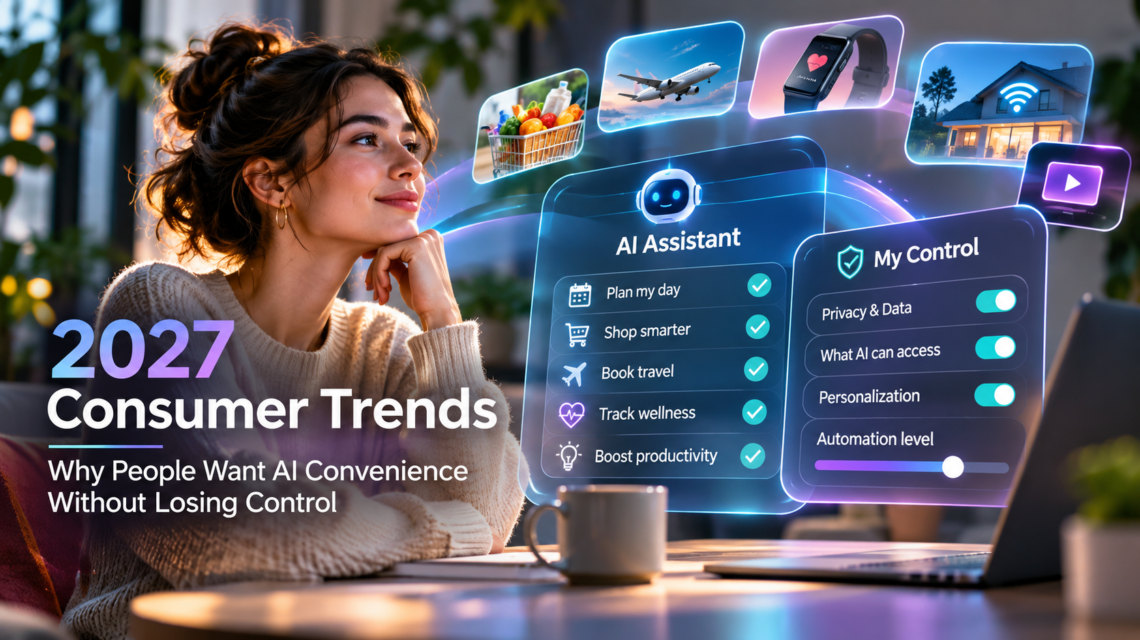
AI is becoming part of how people search, create, work, and make decisions. Yet more automation does not automatically mean more trust. Accenture’s November 18, 2026 announcement of its Life Trends 2027 report describes a tension: consumers are embracing technological progress while resisting experiences that make them feel they have lost control.
This article explores what that tension may mean for digital products, brands, and everyday technology choices. The report is a trend framework, not a universal survey result for every country or demographic, so its themes should be treated as signals to investigate rather than fixed predictions.
Trend 1: People Want AI Help on Their Own Terms
For a practical example of how people can use an AI assistant while checking its capabilities and limits, see our ChatGPT in 2026 guide.
AI can make it easier to find information, generate ideas, and complete routine tasks. But consumers still need to understand what a system is doing, what information it uses, and when it is making decisions on their behalf. Convenience is more likely to feel valuable when people can set boundaries and override the system.
Trend 2: Authenticity Becomes More Valuable
As synthetic content becomes easier to produce, audiences may place greater value on identifiable sources, genuine expertise, original work, and transparent communication. Brands should be clear about what is human-created, AI-assisted, sponsored, or independently verified.
Trend 3: Trust Moves From Claims to Proof
Trust is not created by saying that a product is secure, ethical, or personalised. People need understandable explanations, meaningful controls, accurate information, and evidence that promises match the actual experience.
Trend 4: Personalisation Needs Boundaries
Personalised experiences can reduce friction, but excessive data collection or opaque recommendations can make people uncomfortable. Organisations should explain why information is needed, collect only what is relevant, and provide practical ways to change preferences.
Trend 5: Local Relevance Still Matters
Digital services can operate across borders, but people’s needs are shaped by local language, culture, regulation, payment methods, and availability. A global product may still need local support and clear regional information to be genuinely useful.
What Businesses Can Do
- Give customers control over automated recommendations and actions.
- Explain how data is collected and used in plain language.
- Make it easy to reach a human when a decision is important or disputed.
- Use AI where it solves a real problem, not simply because it is fashionable.
- Show evidence behind product and sustainability claims.
- Adapt service design to local needs and regulations.
How Consumers Can Make Better Choices
Before using an AI-powered service, check what data it needs, whether decisions can be reviewed, how to correct mistakes, and whether there is a human support route. Avoid granting broad account access for a feature that only requires a small amount of information.
Frequently Asked Questions
What are the biggest consumer trends for 2027?
Accenture’s Life Trends 2027 announcement highlights consumer agency, the changing relationship with AI and technology, and expectations for progress that respects people’s choices. Its themes should be read in the context of the report’s methodology and markets.
Are consumers rejecting AI?
Not necessarily. The trend is better understood as selective adoption: people may value AI when it helps them while expecting transparency and control.
Why is authenticity important in an AI-heavy internet?
When content can be produced at scale, readers need clearer signals about source, expertise, sponsorship, and whether claims can be verified.
How can brands build trust in AI experiences?
Explain the system’s role, limit data collection, give users meaningful controls, provide human support for difficult cases, and demonstrate that the experience works as promised.
Conclusion
One useful way to think about the consumer landscape of 2027 is not as a choice between humans and AI, but as a demand for technology that respects human agency. Services that combine convenience with transparency, relevance, and meaningful control may be better placed to earn lasting trust.
Sources and Further Reading
- Accenture: Life Trends 2027 — announcement dated November 18, 2026.
Editorial note: A trend report provides an interpretive framework. It does not prove that every consumer or market shares the same preferences.

 AI Agents: What They Can Do, Where They Fail, and How to Use Them Safely
 AI’s Growing Power Demand: Data Centers, Electricity Grids, and the Energy Challenge
 How AI Is Accelerating Scientific Discovery: From Materials to Medicine
 Agentic Payments Explained: How AI Agents Could Change Digital Transactions
 AI Search and Social Search in 2026: How People Discover Information
 ChatGPT in 2026: Features, Memory, Projects, Search & How to Use It