 Abdur Razzak
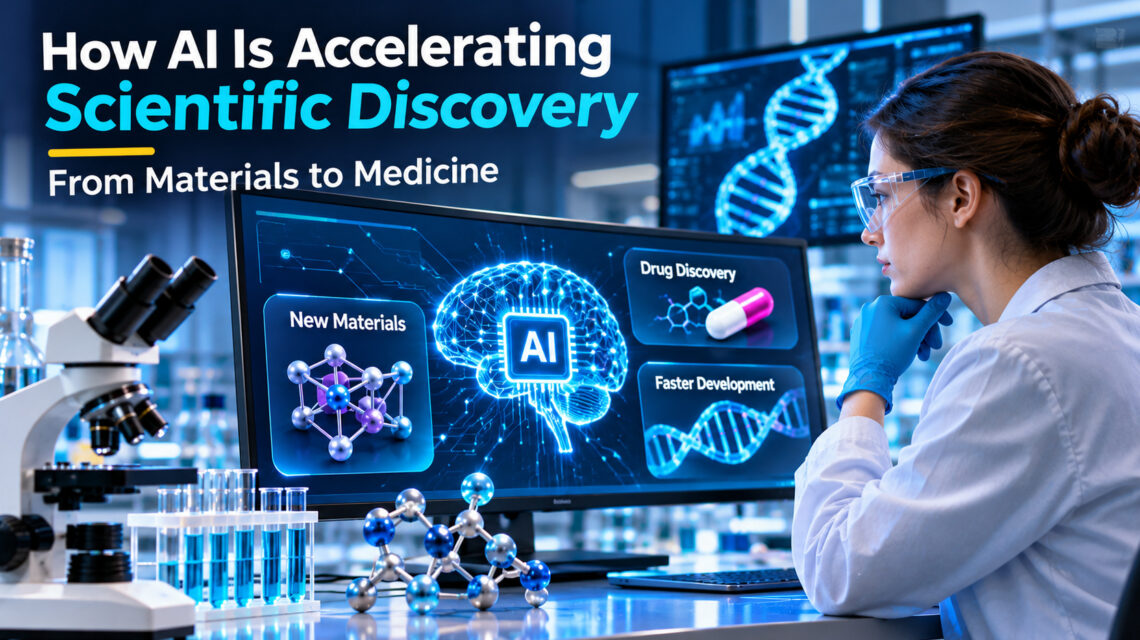
Scientific discovery often involves searching through enormous spaces of possible materials, molecules, designs, or explanations. AI systems can help researchers narrow those possibilities, analyse data, and prioritise experiments. The promise is not that software replaces the scientific method, but that it may help researchers decide what to investigate next.
A concrete example is NVIDIA’s November 16, 2026 Rubin HPC announcement. NVIDIA describes the platform as designed to accelerate simulation and data processing used in science, engineering, and analytics. The company says these systems can help researchers explore candidate materials, molecules, and designs. This is a hardware announcement describing intended capabilities, not peer-reviewed evidence that a specific scientific or medical result has been achieved.
How AI Supports Scientific Research
AI supports scientific research by helping researchers analyse complex data, identify patterns, and explore potential materials or molecules. These capabilities can make research workflows more efficient, while scientists remain responsible for validating predictions through experiments and evidence.
Finding patterns in large datasets
Machine-learning methods can help analyse complex datasets and identify relationships that may be difficult to notice manually. Researchers still need to test whether a pattern is meaningful, robust, and relevant to the scientific question.
Prioritising candidate materials and molecules
Models can rank or predict properties of candidate compounds and materials, helping teams decide which options deserve more detailed simulation or laboratory testing. Predictions are hypotheses, not experimental confirmation.
Accelerating simulations
High-performance computing can make some simulations faster or allow researchers to explore more candidate configurations. Simulation results remain dependent on model assumptions, numerical methods, and input data.
Supporting literature review
AI-assisted search and summarisation can help researchers navigate large bodies of literature. Citation checking and reading the original paper remain essential because summaries can omit methods, caveats, or contradictory findings.
From AI Prediction to Experimental Evidence
A useful research workflow separates computational suggestions from validated findings:
- Define the research question. Specify the property, mechanism, or outcome being investigated.
- Prepare the data. Check provenance, quality, labels, missing values, and possible bias.
- Train or select a model. Document its intended use, training data where known, and validation approach.
- Generate candidate hypotheses. Use predictions to prioritise—not replace—scientific reasoning.
- Run independent tests. Validate important predictions with appropriate simulations or experiments.
- Report limitations. Describe uncertainty, failed attempts, reproducibility, and the conditions under which results apply.
Where the Evidence Still Needs Care
AI-assisted discovery can be limited by poor-quality data, weak generalisation, hidden assumptions, and difficulty reproducing results. A model may perform well on a benchmark while failing on a different laboratory setup or a new class of compounds. Researchers should report the comparison baseline and the evaluation conditions clearly.
There is also a difference between accelerating a step and proving a scientific breakthrough. Faster candidate selection does not by itself establish that a predicted material can be manufactured, that a molecule is safe, or that a treatment is effective.
AI in Materials Science and Medicine
In materials research, AI can assist with screening candidate compositions, estimating properties, and guiding simulations. The next step is usually synthesis, characterisation, and testing under the intended operating conditions.
In medicinal chemistry, models can help interpret molecular structures and experimental evidence or suggest candidates for further investigation. Drug development still requires a long sequence of chemical, biological, preclinical, and clinical validation. A computational result should never be described as a proven therapy.
How to Evaluate an AI Science Claim
| Question | Why it matters |
|---|---|
| Was the work peer reviewed? | Shows whether the methods have received formal scholarly scrutiny, though it does not guarantee correctness. |
| What data and benchmark were used? | Clarifies the scope and limits of the result. |
| Was there experimental validation? | Separates a model prediction from an observed scientific result. |
| Can independent teams reproduce it? | Tests robustness beyond the originating group. |
| What remains uncertain? | Prevents a narrow result from being overstated. |
Frequently Asked Questions
Can AI make scientific discoveries on its own?
AI can generate predictions and help researchers explore hypotheses, but scientific claims still require appropriate validation, interpretation, and scrutiny.
Does AI replace laboratory experiments?
No. Models can prioritise experiments or reduce some computational workloads, but physical and biological systems often need experimental confirmation.
Can AI speed up drug discovery?
AI can support parts of early discovery, such as analysing molecular data or prioritising candidates. It does not remove the need for safety studies and clinical trials.
What is the main risk of AI in science?
One major risk is treating predictions as established evidence. Data quality, uncertainty, reproducibility, and independent validation must remain central.
Conclusion
AI is becoming an important tool in the scientific workflow, from searching research literature to screening candidate materials and accelerating simulations. Its most credible contribution is helping scientists direct attention and resources more efficiently. The scientific method remains essential: predictions need testing, uncertainty needs reporting, and results need independent scrutiny.

 AI Agents: What They Can Do, Where They Fail, and How to Use Them Safely
 Agentic Payments Explained: How AI Agents Could Change Digital Transactions
 2027 Consumer Trends: Why People Want AI Convenience Without Losing Control