 Abdur Razzak
Digital payments are moving beyond the visible checkout button. As software agents become capable of comparing options and taking actions through connected services, a new question emerges: could an AI agent choose how and when to pay within limits set by the customer or business?
McKinsey’s 2026 Global Payments Report, published September 25, describes a shift toward what it calls agentic payment activity, where software can select material transaction parameters at execution time. This is different from an ordinary recurring payment, where the amount and schedule are set in advance. The distinction matters because delegated decisions require stronger controls around identity, consent, and accountability.
What Are Agentic Payments?
Agentic payments are transactions in which a software agent can make some payment-related decisions at runtime under authority granted by a person or organisation. Depending on the design, it might select a merchant, timing, payment rail, or other transaction parameters within a defined policy.
This is not the same as a subscription renewal or a scheduled bank transfer. In those cases, the user typically decides the essential parameters in advance. An agentic workflow gives the software discretion to choose among options at the time of execution.
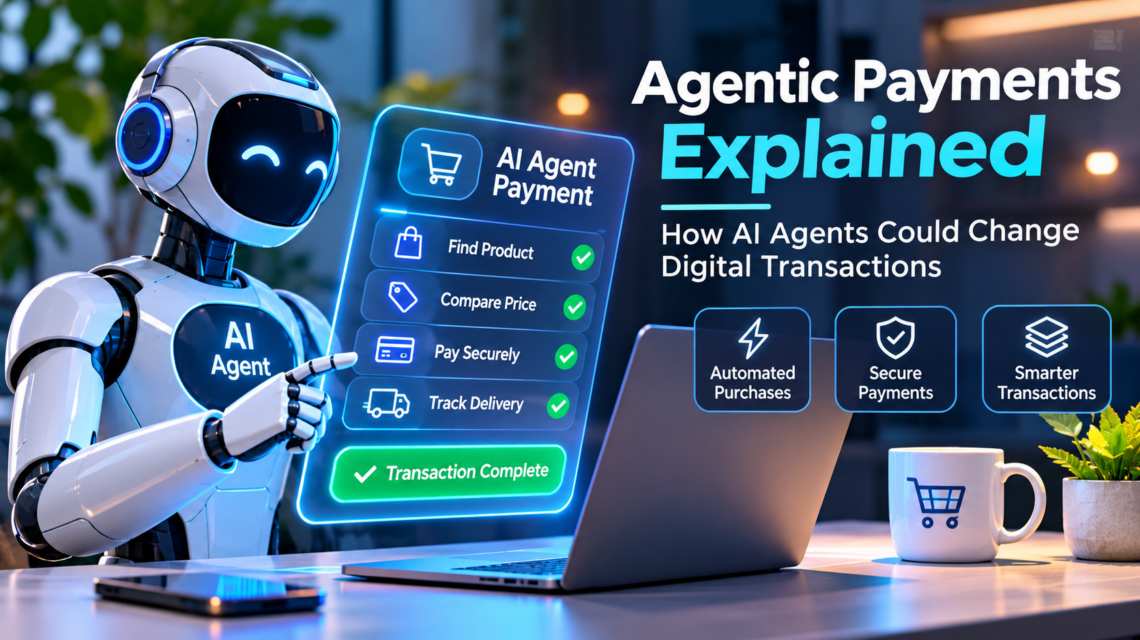
How the Process Could Work
- Set the mandate. The user defines the purpose, spending limits, approved merchants or categories, and expiry.
- Establish identity. The platform verifies the user, agent, and relevant payment credentials.
- Compare options. The agent evaluates eligible routes or offers against the mandate.
- Check policy. The system validates limits, consent, fraud rules, and any required authentication.
- Execute or request approval. The transaction proceeds only when the policy allows it; higher-risk transactions can require confirmation.
- Record the decision. The user can review what was purchased, why the option was selected, and which rules applied.
Why Payment Infrastructure Matters
McKinsey’s report argues that value may shift from the checkout interface toward the systems that establish machine identity, consent management, dynamic routing, and automated policy enforcement. An agent cannot be trusted to spend money merely because it can call a payment API. The transaction system must know which agent is acting, whose authority it is using, and what that authority permits.
Potential Benefits
- Less repetitive work: routine procurement or eligible purchases may require fewer manual steps.
- Dynamic choice: an agent may compare available payment routes or timing when the rules allow discretion.
- Workflow integration: payments could be initiated inside approved business software rather than through a separate checkout experience.
- Operational efficiency: some reconciliation, approval, and routing tasks may become more automated.
Risks: Consent, Fraud, and Consumer Control
Unclear authority
Users must know what they have authorised. A broad mandate can be difficult to understand and may allow more discretion than intended.
Compromised credentials or agents
Machine identities and payment credentials need strong protection, revocation, and monitoring. A compromised agent should not inherit unlimited purchasing power.
Opaque decisions
Customers need a clear record of why a transaction occurred and which alternatives were considered. Without this, disputes become harder to investigate.
Regulation and liability
Rules for payments, data protection, fraud prevention, and consumer protection differ by jurisdiction. Who is responsible when an agent makes an unauthorised or mistaken purchase must be clear before commercial deployment.
Traditional Automation vs Agentic Payments
| Payment type | Who decides key details? | Example |
|---|---|---|
| Manual | Person at transaction time | Customer taps a card or confirms checkout |
| Streamlined | Person decides; software reduces steps | Saved card or biometric one-click payment |
| Scheduled / invisible | Person sets the rule in advance | Subscription or scheduled transfer |
| Agentic | Agent selects some parameters at runtime within a mandate | Approved procurement agent selecting a supplier or payment route |
What Businesses Should Prepare
- Use machine identities that can be individually authenticated and revoked.
- Build clear consent records and transaction limits.
- Require step-up approval for unusual, high-value, or irreversible payments.
- Keep auditable decision logs that support disputes and compliance reviews.
- Test failure modes, including duplicate requests, compromised credentials, and incorrect merchant information.
- Explain the payment experience in customer-friendly language.
Frequently Asked Questions
Are AI agents already able to make payments?
Some controlled systems and industry experiments are exploring agent-enabled transactions. Availability, legal status, and safeguards vary by provider and jurisdiction; do not assume a general-purpose AI assistant can spend money autonomously.
How are agentic payments different from subscriptions?
A subscription follows a decision and schedule set in advance. An agentic payment may involve the software selecting transaction details dynamically at the time it acts.
Are agentic payments safe?
Safety depends on identity verification, narrow permissions, transaction limits, consent, monitoring, dispute handling, and legal protections. The label alone does not make a payment system safe.
Will agentic payments replace cards and digital wallets?
That is not established. Agentic software may use existing payment rails or new infrastructure, and people are likely to retain a role in setting limits and reviewing important transactions.
Conclusion
Agentic payments could move parts of the purchasing decision from people to software, but the critical challenge is not simply enabling automation. It is creating reliable systems for identity, consent, policy enforcement, and accountability. Businesses should treat delegated payment authority as a governance and security problem as much as a technology opportunity.
Sources and Further Reading
- McKinsey: The 2026 Global Payments Report — published September 25, 2026.
- Developing Consumer Trust in Sustainable Agentic Commerce — conceptual research published October 29, 2026.
Editorial note: This article is general information, not financial or legal advice. Product availability and regulatory requirements vary by jurisdiction.

 AI Agents: What They Can Do, Where They Fail, and How to Use Them Safely
 AI’s Growing Power Demand: Data Centers, Electricity Grids, and the Energy Challenge
 How AI Is Accelerating Scientific Discovery: From Materials to Medicine
 AI Search and Social Search in 2026: How People Discover Information
 2027 Consumer Trends: Why People Want AI Convenience Without Losing Control
 ChatGPT in 2026: Features, Memory, Projects, Search & How to Use It